Tag Archives: editing

How Historically Accurate Should Fantasy Be?

In the spring, I joined Threads, and what a vibrant literary community that app has! Shortly after joining Threads, I encountered a lively debate there regarding the use of “fuck” in fantasy and whether it was anachronistic. Some replies argued that in fantasy, you can do what you want, which sparked counterarguments about respecting genre rules. It’s been a few months since this debate, but I have thoughts on this that I couldn’t fit into a Threads post, and I wanted to weigh in!

As is often the case, my stance is somewhere in the middle. One of my favourite aspects of the fantasy genre is the freedom to be creative with your decisions. In many ways, your imagination is the limit in fantasy, but I also feel that you owe readers believability within the world you build. This may mean avoiding anachronisms…but it may not.

I think of the lamppost in Narnia, for example. Perhaps that’s anachronistic, but it works within the world. If it’s conscious, deliberate, and justifiable within the world’s logic, perhaps there isn’t a problem.

To me, other elements are more important than whether you include or avoid certain cursewords or lampposts. I think readers can forgive certain quirks, especially if you, the author, have a reason for them. Less forgivable are flat characters, unbelievable plot lines, or clunky dialogue. 

And in terms of the original debate over “fuck,” that word actually dates back to the fourteenth century, according to Merriam-Webster, so sometimes readers perceive certain elements as anachronistic even if they aren’t. You can’t please everyone, so I think it’s better to make strong world choices and commit. 

Personally, I have no problem with “fuck” in fantasy (and if you’ve read Into Shadow, you’ll know I have used it myself). I feel that language my audience connects with is the best language for me to use.

I also feel that fantasy can be inspired by a particular era without being ruled by it. If you write historical fantasy, this may not be the case, but in epic fantasy, I think it’s very fair to pick and choose from different eras. The goal is not to accurately reflect an era, but rather to build a believable world from a variety of influences to make your point and serve your story. If that includes some anachronisms, historical accuracy was never the point, really.

So, I’m not totally against anachronisms in fantasy. If an anachronism is logical within the story and serves the story, I think it’s fine! However, in fantasy, rules matter within the context the author builds, so while you make the rules, you also need to follow them. This may be something difficult to judge by yourself, and if you consciously include anachronisms, it’s important to listen to beta reader and editor feedback. I think all authors want to create a good reader experience, so if it stands out to your readers as not working, then maybe you should rethink the anachronism. But if your anachronism serves your world and it works for your early readers, I think it can be okay.

What are your thoughts on historical accuracy in fantasy? Comment below!
Who Needs “Whom,” Anyway?

As I was scrolling through social media, I came across a comment by another editor saying that “whom” should never be used because it’s obsolete. This came days after a conversation I had with a friend about something in grammar called a predicate complement. Not to get too technical, but when you use a verb form of “to be” followed by a pronoun, that pronoun should be in the subjective case. In case I’ve lost you, I’ll give you a quick example: if you’ve ever heard someone answer the phone with “This is she,” that’s technically grammatically correct.

This came up because I was talking about Taylor Swift’s song “Anti-Hero” and predicate complements. This subject makes me laugh, because “It’s me” should technically be “It’s I,” which sounds ridiculous in that song. My friend commented that if no one uses that form, is it really correct? 

I loved this comment so much that I decided to write a blog post about it. Whether to use “who” or “whom” and whether to use predicate complements boils down to what school of editorial thought you’re part of, and these two conversations really had me considering my own stance.

In editing, there are basically two ways of thinking:

1. You should edit according to the rules.

2. You should edit according to how people actually use English.

I think many editors, including myself, fall somewhere in between. I love knowing the rules, but it’s limiting as a language professional to stick to the rules in all instances because no piece of writing is the same. Authors have different voices, and texts have different audiences. If you were writing a children’s book, you wouldn’t use the same style as you would to write a dissertation, so editing, like many things, requires some nuance and flexibility based on the purpose of the text.

In all cases, it’s important to consider audience expectations. When you’re writing in a more formal register, your audience will expect you to follow certain rules, even if they’re rules without a real grammatical basis. Many people incorrectly assume that you can’t start a sentence with a coordinating conjunction (like “and” or “but”), that you can’t split an infinitive, or that you can’t end a sentence with a preposition. While these rules aren’t actually rules, if your audience considers them to be rules, you may be better off following them. However, if you choose not to follow them, the good news is that there are plenty of resources to prove that you’re right. 

So, should you use “whom”? My answer is that it depends. If you’re writing in a formal register, I would say yes. If you’re writing fiction, I would also say it depends. Are you writing in the voice of a character who loves grammar? Are you writing a historical fiction novel in the style of the time? In that case, maybe. Otherwise, maybe not. 

My general philosophy is to know your rules and to not be afraid to break them if the context calls for it. Language is beautifully fluid, and it evolves over time. The most important thing is to reach your audience with language that they will be able to understand and connect with. After all, grammar is just a tool to help you effectively communicate.

Introducing… the Author

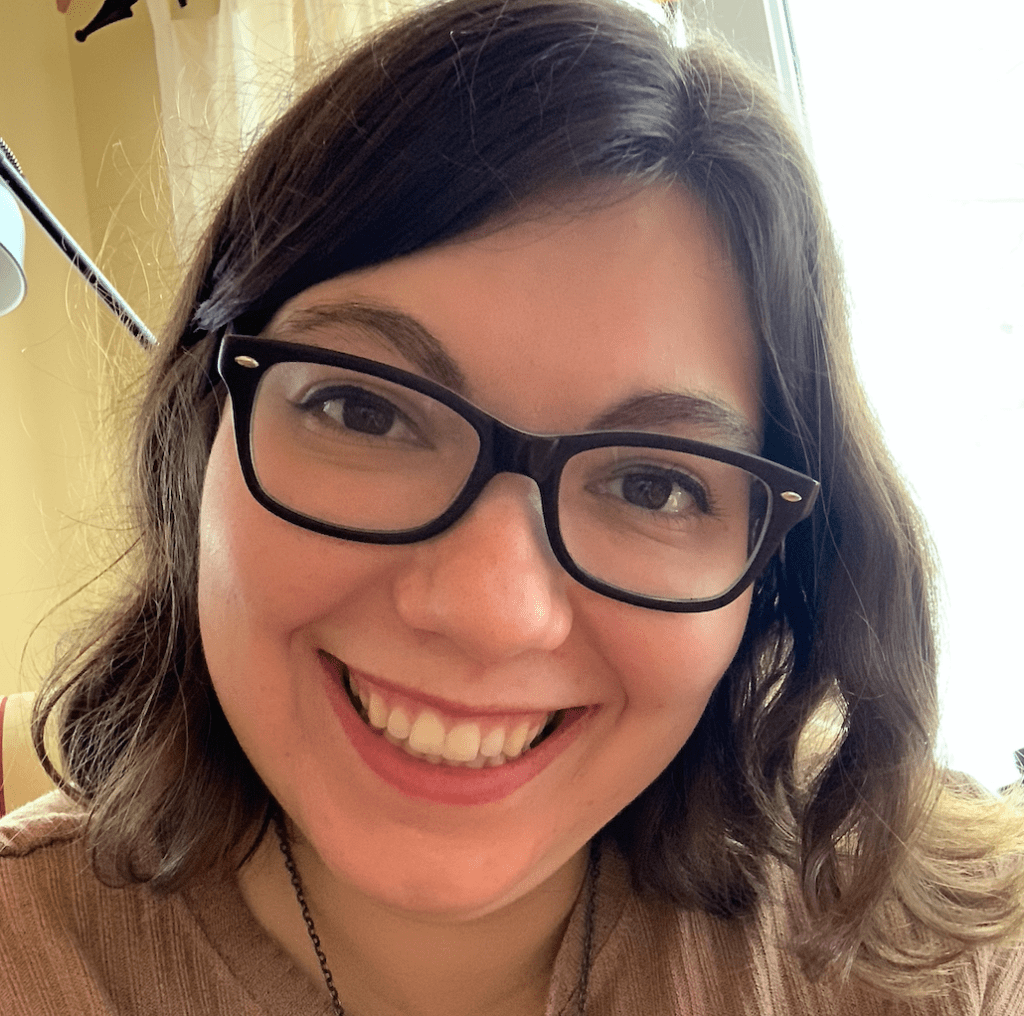
Hello and welcome to my website! I’m Laura K. E. Jones, a Canadian fantasy writer, copy editor, and audiobook narrator. Here’s a fairly recent picture of me (December 2021), so you can put a face to the name.

**Fun fact: I decided to use my middle initials in my pen name because “Laura Jones” is such a common name.**

I feel as if my genre chose me, rather than the other way around. I never made a conscious decision to write fantasy, but I’ve always been drawn to magic and other worlds, so it’s naturally what I gravitate towards when I write. In fact, I have trouble writing anything set in the real world! In terms of reading, I’m also a fantasy lover (although I’m very picky about the fantasy I read!), but I try to read a variety of things, and I really enjoy a good history book.

I’m from Edmonton, Alberta, Canada, but I’ve also lived in Halifax (Nova Scotia), Fredericton (New Brunswick), and Mascouche (which is just outside of Montreal, Quebec). I’ve been lucky enough to travel a lot, and my travels have taken me from Angkor Wat to the top of Kilimanjaro. I especially love Prague, because stepping into the main square feels like stepping back in time, and I also love Paris and Venice. 

**Another fun fact: I love pigeons, which may be why I like Venice so much. I feel like pigeons and dandelions don’t get enough love, so I love them a lot to make up for it.**

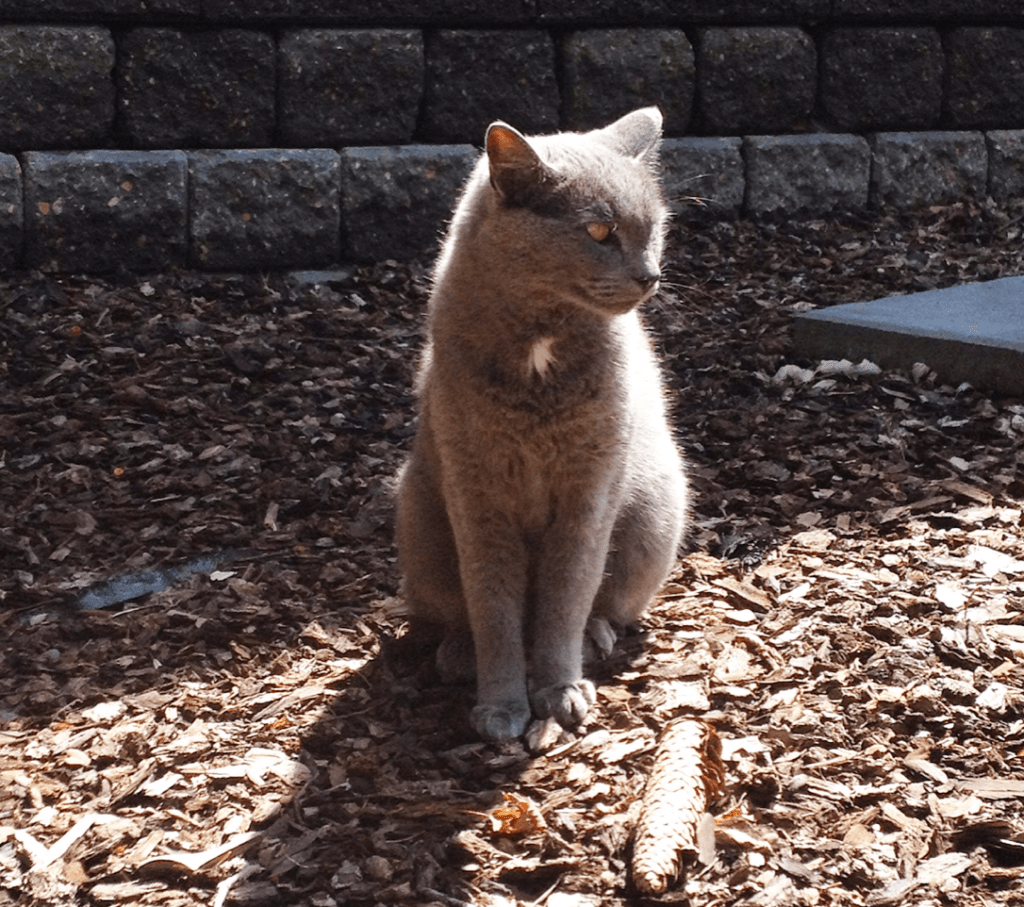
I have a very old cat (seventeen years old!) named Ollie. He’s extremely cuddly and loud. He’s grey, with a white patch on his chest. This is Ollie:

I attended university in Halifax, Nova Scotia, where I got a Bachelor of Music. My instrument was voice, and my major was musicology (which is basically music history). My teachers all disagreed on whether I was a mezzosoprano or a soprano, so I’ve just accepted that I’m vocally divergent. In addition to singing very loudly, I also play piano. Chopin and Debussy composed some of my favourite piano pieces, and my all-time favourite piece is “La fille aux cheveux de lin.”

Because I studied opera, I sang regularly in French, Italian, and German. My spoken French is pretty rusty, though. I took a year of German in university, but I’ve forgotten just about all of it. Some of my favourite operas include Le Nozze de Figaro, Carmen, and Tosca.

I used to do a lot of theatre, with roles ranging from Carol in Black Comedy to Eponine in Les Misérables. I’ve also been in Grease, Legally Blonde, and Chat Blanc: Lost in Montmartre, an Edmonton Fringe show about the French composer Satie, which included a shadow puppet opera! 

During my undergraduate degree, I realized I didn’t like performing anymore. I persisted for a bit and was even a finalist in the Northern Alberta Concerto Competition in 2020, right before the pandemic hit. However, I had the distinct thought “get me off of this stage” during that performance, so I gladly accepted my loss and decided that the competition would be my last solo performance.

**Yet another fun fact: I’ve been vegetarian for fourteen years for ethical reasons, and I’m really glad I made that decision.**

I study publishing at Toronto Metropolitan University, and I do some freelance copy editing work. I also studied journalism for four months. While journalism definitely wasn’t for me, I did discover a passion for audio there, and I now read audiobooks!

I’ve always been a reader, and I started writing stories as a child. I began writing more seriously once I reached university, and I finished my first full-length novel at eighteen. I’ve dabbled a bit in fanfiction over the years, and I’m grateful that it provided the opportunity for me to build my skills and confidence. I first fell in love with writing through fanfiction and quickly realized that I wanted to do it forever! Writing is my passion, and I work hard at it. 

I’m currently querying my novel Into Shadow, affectionately known to me as Dragons!, which was its working title. It was a finalist in a publisher’s speculative fiction contest, and although it wasn’t picked in the end, I’m very grateful to have been a finalist, if only because it helped give me some confidence in my writing. I’ve also had the chance to continue improving Into Shadow since then, and I’m feeling good about the shape it’s in now!

I love the mountains and hate the ocean. Hiking and backcountry camping are wonderful. Mountains often make it into my book settings. I also love the prairies, maybe because that’s what I’m used to. However, I do love the big snowstorms in Eastern Canada much more than the extreme cold of the prairies. In Edmonton, we don’t get as much snow, but we do get a few weeks each year that are consistently colder than thirty degrees below zero. Yes, that’s as awful as it sounds. I love big storms, both the thunder and snow variety. 

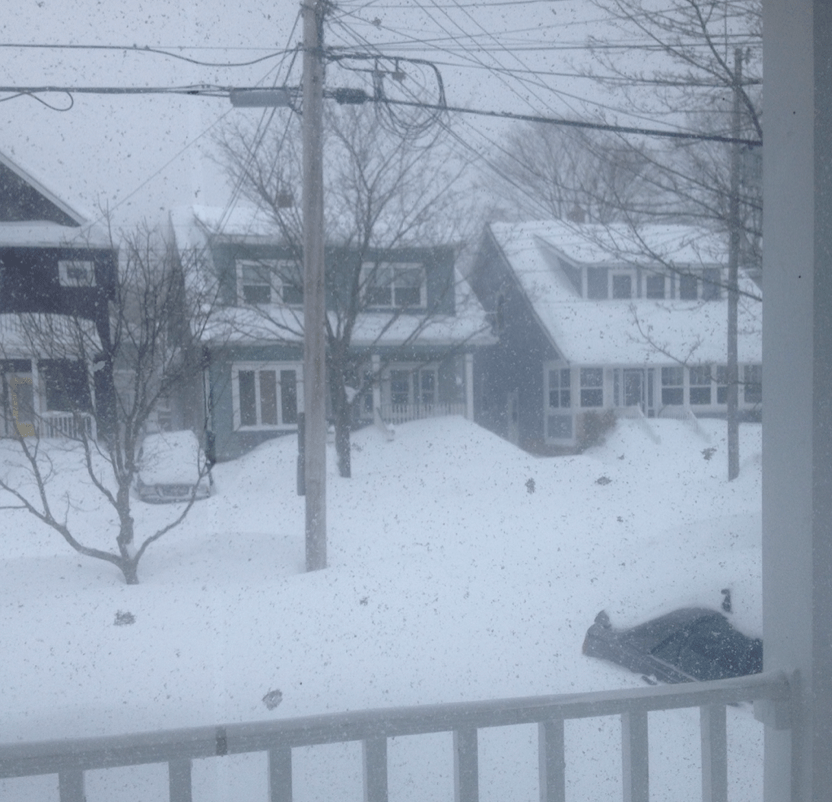
Here’s a picture of the aftermath of a Halifax snowstorm:

And here’s a picture of the Rockies, so you can see why I’m a mountain girl! This is in the Tonquin Valley:

**Another fun fact: I collect rocks and mugs as well as journals. My favourite mug has a t-rex in it, which makes me laugh because when I have tea, it’s a “tea-rex.” The mugs come in handy, because I drink way too much coffee. I also have a quirky earring collection, with some of my favourites being pine cones, spoons, clocks, cats, and mini copies of The Book Thief (which is one of my all-time favourite books).**

I have a very eclectic music taste that no one understands, myself included. Why do I like One Direction and musicals, but also Bardcore, ’80s music, and opera? None of it makes sense. 

I have notoriously bad luck, such as falling into a mud puddle on my first real day of work. I kill every plant I touch, even cactuses. Seriously, never ask me to look after your plants, because they will die.

**One more fun fact: I wear glasses and can barely see without them. I’ve tried the contacts thing but my eyes hate them!**

I love poetry and occasionally dabble in writing it. Novels are my love, though! When I’m not writing, I’m often daydreaming about stories. 

If you’ve read this far, you probably know more about me than you ever wanted to, so I may end things here. Thanks for reading!